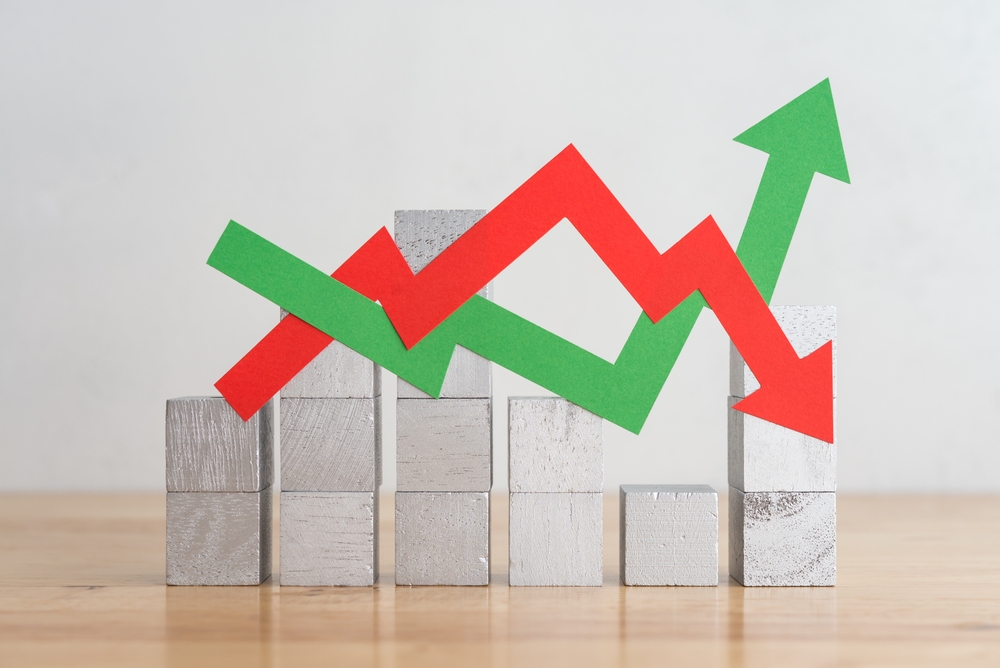
S Fund volatility was on full display in July. After a 4.34% surge in June, which saw it lead the core funds, the S Fund became the weakest performer one month later, reminding investors why small-cap stocks often experience larger swings than the broader market.
The swing wasn’t unusual. In fact, it perfectly illustrated why the S Fund has long been considered the most volatile of the core TSP funds.
July 2026 TSP Performance
Fund
July 2026
YTD
12 Months
G Fund
+0.39%
+2.57%
+4.42%
F Fund
-1.29%
-0.56%
+2.74%
C Fund
-0.07%
+10.13%
+19.54%
S Fund
-4.12%
+13.52%
+20.78%
I Fund
-1.01%
+15.35%
+30.72%
What Happened?
Every stock-oriented TSP fund finished July lower, but the declines weren’t equal.
The S Fund, which tracks small- and mid-sized U.S. companies, fell the most. The C Fund, made up of large-cap companies in the S&P 500, also declined but held up considerably better. The I Fund gave back some of its strong gains as international markets cooled, while the G Fund once again provided its characteristic steady return with no market risk.
That’s exactly what investors should expect from the S Fund.
Smaller companies often react more dramatically to changes in investor sentiment, interest-rate expectations, and economic outlook than the larger companies that dominate the C Fund. That higher sensitivity can produce impressive gains during strong rallies—and steeper declines when markets pull back.
One Month Doesn’t Tell the Story
Looking only at June, you might have concluded the S Fund was the obvious place to be. Looking only at July, you might reach the exact opposite conclusion. Neither would be particularly useful.
Retirement portfolios aren’t built one month at a time. They’re built over years of contributions, market advances, corrections, recoveries, and continued investing through all of it.
The S Fund didn’t suddenly become a bad investment because of one difficult month, just as it didn’t become the perfect investment after one exceptional month. Both results were examples of the same characteristic: higher volatility.
What Should Federal Employees Take Away?
The biggest lesson isn’t about the S Fund itself. It’s about avoiding the temptation to chase performance.
A strong month often makes investors want to increase their allocation just as a weak month makes them want to reduce it. Unfortunately, those emotional decisions frequently happen after prices have already moved.
Successful long-term TSP investing usually comes from maintaining an allocation that’s appropriate for your retirement timeline and risk tolerance—not from trying to predict which fund will lead next month.
That doesn’t mean ignoring your investments. Periodic reviews are important. But changing your allocation simply because one fund had a great month or a disappointing one can lead to buying high and selling low.
The Bigger Picture
July didn’t prove the S Fund is too risky. It proved that the S Fund behaves exactly the way it’s designed to.
Federal employees with longer investment horizons often accept that additional volatility because of the potential for higher long-term returns. Those approaching retirement may choose a different allocation because preserving assets becomes a higher priority than maximizing growth.
Neither approach is inherently right or wrong.
The important question is whether your current mix of the G, F, C, S, and I Funds still matches your retirement goals—not whether one fund happened to outperform or underperform over the last 30 days.
June rewarded investors who already owned the S Fund. July tested whether they understood why they owned it in the first place.
If you’re unsure whether your current TSP allocation still aligns with your retirement timeline and comfort with market volatility, a Federal Retirement Consultant (FRC®) can help you evaluate how your TSP fits into your overall retirement strategy.
Frequently Asked Questions
Why is the S Fund more volatile than the C Fund? The S Fund invests primarily in small- and mid-sized U.S. companies, which generally experience larger price swings than the large-cap companies that make up the C Fund.
Should I move out of the S Fund after a bad month? Not necessarily. Investment decisions should be based on your long-term retirement strategy, time horizon, and tolerance for risk—not a single month’s performance.
Is the S Fund a good long-term investment? Many federal employees include the S Fund as part of a diversified TSP portfolio because it provides exposure to companies outside the S&P 500. Whether it’s appropriate for you depends on your investment objectives and risk tolerance.
What is the biggest lesson from July’s S Fund performance? One month’s performance rarely tells the whole story. July demonstrated both the higher volatility of the S Fund and the importance of maintaining a long-term investment strategy rather than reacting to short-term market movements.